



Determinants of CrossOver Distribution
across Eukaryotes

The DeCODE team investigates how DNA repair is controled during meiosis to influence the number and distribution of meiotic crossovers along chromosomes, using plants and fungi models to uncover conserved mechanisms that shape the recombination landscapes.

.

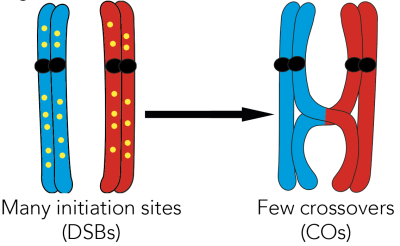
Meiosis is a cornerstone of sexual reproduction, during which crossovers—reciprocal exchanges of DNA between homologous chromosomes—generate new combinations of alleles and help ensure accurate chromosome segregation. Across eukaryotes, many initial precursors are formed early in meiosis, but only few of them will actually turn into crossovers. How do cells decide which DNA precursors become crossovers, and where these crossovers occur? We address this question by exploring the interplay between chromosome organisation, DNA sequence variation and chromatin state. Combining complementary plant and fungal models with quantitative imaging, genomics and targeted molecular perturbations, our research connects the dynamics of crossover designation with the mechanisms that promote or suppress recombination in specific genomic regions. Our four research axes aim to distinguish shared principles from species-specific adaptations.

Fig1_DSB_to_COs : Schematic illustrating meiotic crossover formation.

Axis 1 — Dynamics of crossover designation

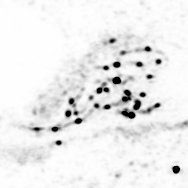
Crossovers are not placed randomly along chromosomes: once a crossover is selected, nearby sites are less likely to become crossovers, a phenomenon known as crossover interference. Using live super-resolution microscopy in the filamentous fungus Sordaria macrospora, we visualise and quantitatively track individual pro-crossover proteins throughout meiosis. By combining live imaging, targeted protein degradation and optogenetic perturbations, as well as genomics, we investigate how crossover sites communicate over long chromosomal distances and test competing conceptual models based on chromosome mechanics and the dynamic coarsening of pro-crossover factor.

CG_20221013_Hei10GFP_Airyscan-Processing_MAX_19-22_T1_INVERTED: Super-resolution fluorescence micrograph of a Sordaria macrospora meiocyte expressing HEI10–eGFP.

Super-resolution fluorescence micrograph of a Sordaria macrospora meiocyte showing crossovers along chromosomes

Axis 2 — Polymorphism and recombination

DNA sequence differences between homologous chromosomes—polymorphisms—can profoundly reshape the crossover landscape. In Arabidopsis thaliana, we have shown that more polymorphic regions can preferentially form crossovers in a manner dependent on mismatch repair (Madec et al, 2026). We are currently investigating how mismatch repair proteins interface with homologous recombination to recognise sequence divergence and influence crossover designation.

Arabidopsis_doodle : Black-and-white botanical drawing of an Arabidopsis thaliana plan

Black-and-white botanical drawing of an Arabidopsis thaliana plant

Axis 3 — Epigenetic recombination drivers

Chromatin state and epigenetic pathways are likely to help determine where crossovers occur, yet their meiotic functions remain poorly understood. We use the complementary fungal models Sordaria macrospora and Podospora anserina, together with the FED Team headed by Fabienne Malagnac (I2BC) to uncover how RNA silencing, DNA methylation and histone modifications shape the recombination landscape. Time-controlled protein depletion allows us to study essential or pleiotropic genes specifically during meiosis, separating their recombination functions from earlier developmental requirements. This work connects chromatin organisation and genome defence pathways to the control of meiotic DNA repair.

Sordaria_doodle : Black-and-white botanical drawing of a cut-open Sordaria macrospora fruiting body.

Black-and-white drawing of a cut-open Sordaria macrospora fruiting body

Axis 4 — Recombination suppression

Large chromosomal regions with little or no recombination have evolved repeatedly around sex-determining loci, helping preserve co-adapted combinations of alleles. We investigate the molecular bases of this suppression in fungi, focusing on the mating-type-proximal regions of Podospora anserina, and in collaboration with Bertrand Llorente (CRCM Marseille) the budding yeast Lachancea kluyveri. We test how local DNA sequence features, chromatin states and chromosome-axis composition inhibit crossover formation, and how nearby recombination hotspots interact with these silent domains. The aim is to identify whether distinct organisms have evolved common or different mechanisms to establish stable recombination-suppressed regions

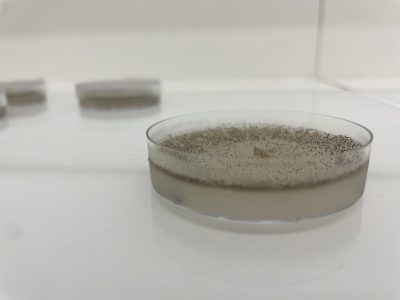
Sordaria_petri : Photograph of a Petri dish containing a dense, pale Sordaria macrospora fungal culture covered with numerous small dark fruiting bodies.

Photograph of a Petri dish containing a dense, pale Sordaria macrospora fungal culture covered with numerous small dark fruiting bodies

team

GIRARD Chloé
Group Leader Researcher
RODRIGUES NEVES Ana Rita

Researcher

Publications

For all the publications of the Team click on the button below.

External funding

JCJC POLYREC 2021-2024

RING


2024-2026

StG DYNACO 2024-202

PRCE MARS 2027-2031

Scroll to Top